
Rhyme Generator
Stuck on the end of a line? Type a word and this rhyme generator lists perfect rhymes, near rhymes that share the vowel sound, and spelling-based matches — sorted by syllables so you can keep the rhythm. Paste a verse into the scheme checker to see its rhyme pattern at a glance.
- Free to use
- No sign-up
- Runs in your browser
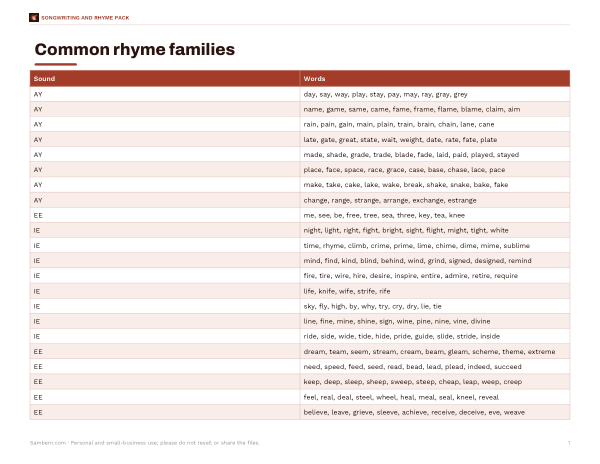
Rhyme generator
Rhyme scheme checker
Songwriting and Rhyme Pack
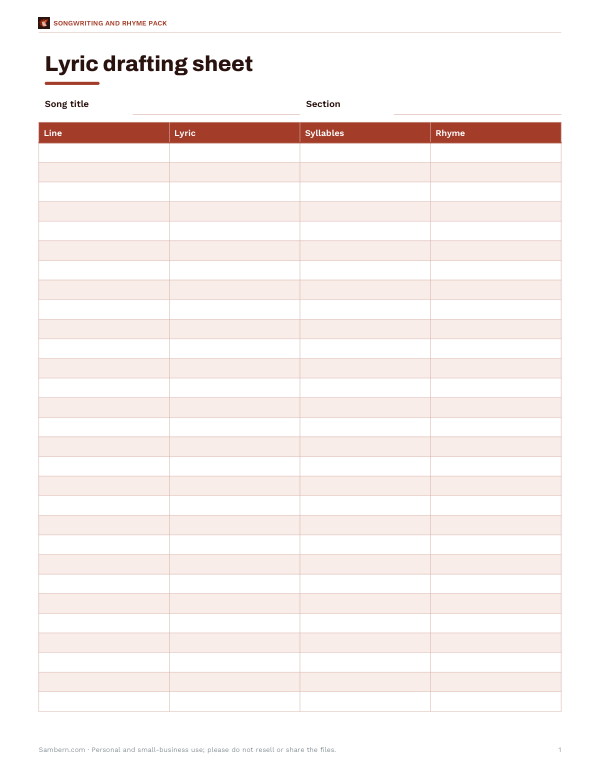
Printable songwriting sheets: rhyme family chart, rhyme scheme reference, lyric drafting template with syllable columns and a song structure planner.
- Rhyme family chart (PDF/XLSX)
- Scheme reference (PDF)
- Lyric sheet (PDF/DOCX)
- Structure planner (PDF/DOCX)
Formats: PDF, XLSX, DOCX. Instant download after payment (link valid 72 hours, up to 5 downloads). AI-assisted: the templates were drafted with AI help and reviewed and laid out before publishing.
$5.00 USD, one-time 4 files · about $1.25 each
- Instant download
- 7-day refund
- Secure checkout by Stripe
7-day money-back guarantee. Full refund within 7 days of purchase, even after you download.
Free sample: Lyric Drafting Sheet (PDF, 52 KB)
Full refund within 7 days — see the refund policy and license.
Free printables
Single sheets you can print right now, no sign-up. The full pack adds every sheet in one download plus the editable files.
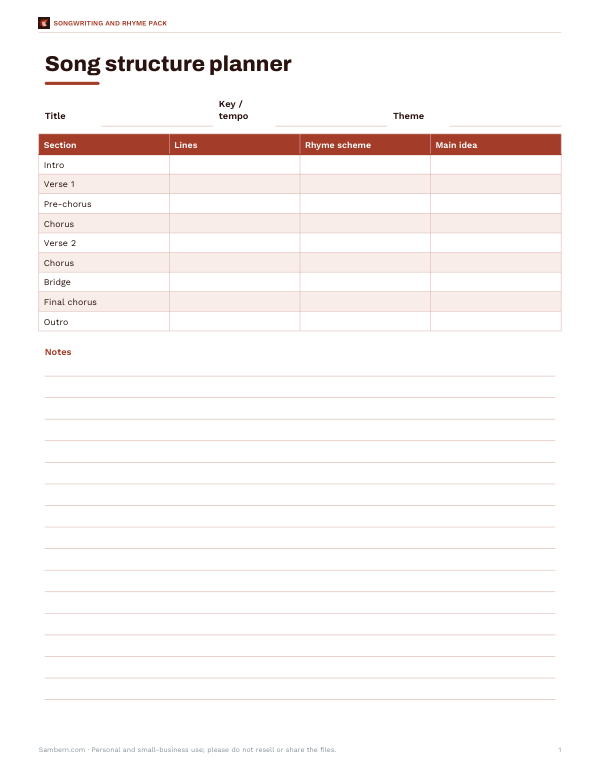 Printable Song Structure Planner
Types of rhyme
| Type | What matches | Example |
|---|---|---|
| Perfect (true) rhyme | The stressed vowel and every sound after it | light / night; nation / station |
| Near (slant) rhyme | Similar vowel or final consonants, not both | home / stone; love / enough |
| Assonance | Vowel sounds only | lake / fate / rain |
| Consonance | Final consonant sounds only | blank / think |
| Eye rhyme | Spelling, not sound | love / move; cough / through |
| Multisyllabic rhyme | Two or more syllables | feeling / ceiling; potion / ocean |
| Internal rhyme | Rhymes inside a line | “I bring my thing to the ring” |
Songwriters and rappers use near rhymes constantly — they give far more choice than perfect rhymes and often sound more natural. The generator’s near-rhyme list groups words with the same stressed vowel sound.
How this rhyme generator works
The built-in dictionary groups about 950 common English words into families that share a rhyming sound — for example light, night, bright and tonight. Typing a word shows the rest of its family as perfect rhymes, then other families with the same vowel sound as near rhymes. If a word isn’t in the dictionary, the generator falls back to words with the same spelling ending, which usually but not always rhyme (compare “cough” and “bough”). Syllable counts are estimated from spelling and can be off by one for unusual words.
Rhyme schemes
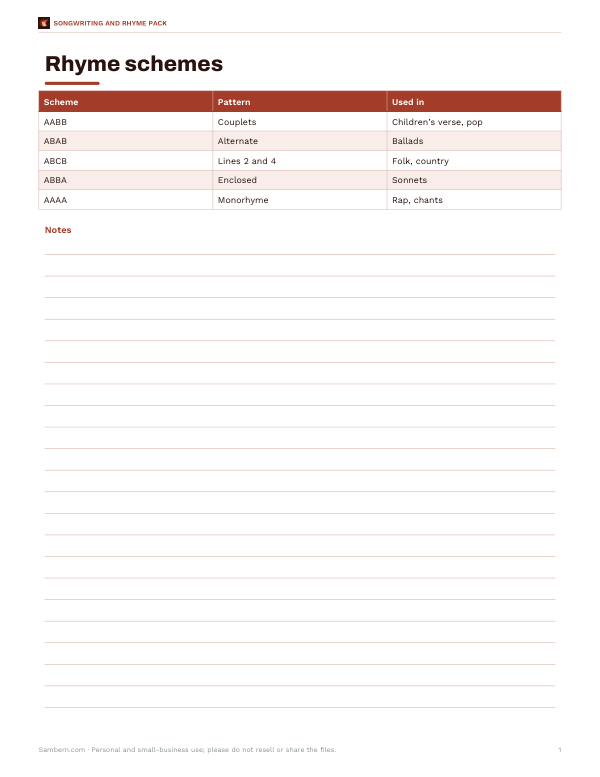
| Scheme | Pattern | Common in |
|---|---|---|
| AABB | Couplets | Children’s verse, many pop songs |
| ABAB | Alternate rhyme | Hymns, ballads, verses |
| ABCB | Only lines 2 and 4 rhyme | Ballads and folk songs — very natural |
| ABBA | Enclosed rhyme | Italian sonnets |
| AAAA | Monorhyme | Rap verses, chants |
| ABAB CDCD EFEF GG | Shakespearean sonnet | Sonnets |
The scheme checker labels the last word of each line with a letter: lines ending in rhyming words share a letter. It also estimates the syllables in each line, which helps keep lines a similar length for singing.
Worked example
A songwriter has “I walked alone beneath the night / The city hummed in yellow light” and needs the next couplet. Looking up “go” gives perfect rhymes such as slow, know, below and tomorrow, and near rhymes like home, alone and stone. They choose “I didn’t know which way to go / The streets were quiet, soft and slow”. The scheme checker shows AABB, with each line around eight syllables — a steady rhythm for the melody.
Tips for better rhymes
- Write the line’s meaning first, then find the rhyme — forcing a rhyme often forces the sense.
- Put the rhyming word where the natural stress falls.
- Mix one-syllable and multi-syllable rhymes for variety.
- Avoid over-used pairs (love/above, fire/desire) unless you give them a twist.
- Try swapping the lines so the stronger word lands at the end.
- Read lines aloud — rhyme is about sound, not spelling.
Finding rhymes for hard words
| Hard word | Approach | Options |
|---|---|---|
| orange | Near rhyme or split across words | door hinge, porridge (near) |
| month | Near rhyme on the vowel | once, front, hunt |
| purple | Multisyllabic near rhyme | circle, turtle, hurdle |
| silver | Near rhyme | deliver, river (near) |
| love | Avoid the cliché pairs | enough, tough (near), of, glove |
| heart | Plenty of perfect rhymes | start, apart, art, smart |
When no perfect rhyme fits, change the line so a different word lands at the end — often the best fix.
Stress and rhythm
Rhymes only work when the stressed syllables line up. “Nation” and “station” rhyme because both stress the first syllable and share -ation; “define” and “feminine” don’t really rhyme even though they look similar, because the stress falls in different places. When choosing a multisyllabic rhyme, say both lines aloud and tap the beat: the rhyming syllables should fall on the same beat in each line. The syllable counts in the scheme checker help keep lines balanced, but the stress pattern matters more than the exact count.
Rhyme and meaning
Good rhymes feel inevitable, as if the rhyming word were the natural thing to say. If a rhyme drags the line off topic, try a near rhyme with a better meaning. Many songwriters list every possible rhyme first, then pick the one that adds a new image or twist rather than the most obvious one.
Rhyme in different forms
Nursery rhymes and greeting-card verse favour perfect rhymes in couplets. Pop and country songs mix perfect and near rhymes, often in ABCB patterns. Hip-hop leans on multisyllabic and internal rhymes and on assonance across whole lines. Modern poetry frequently uses slant rhyme or no rhyme at all, relying on rhythm and imagery. Knowing which you are writing helps you choose which lists to use.
Privacy
Everything runs in your browser; your words and verses are not uploaded or saved.
Frequently asked questions
What rhymes with light?
Night, bright, sight, flight, might, tight, white, kite, write, tonight, delight and more.
What is a near rhyme?
Words with similar but not identical sounds, such as home and stone or love and enough.
What is a perfect rhyme?
Words whose stressed vowel and following sounds match exactly, like cat and hat.
Why isn’t my word found?
The built-in dictionary covers common words; for others, the generator suggests words with the same spelling ending.
What is the rhyme scheme ABAB?
Lines 1 and 3 rhyme, and lines 2 and 4 rhyme.
Is my writing saved?
No. It stays in your browser.
What rhymes with orange?
Almost nothing perfectly; near rhymes and split rhymes like “door hinge” are the usual solution.
How do I find multisyllable rhymes?
Set the syllable filter to 2 or 3+, and look for words sharing the last two stressed sounds, like feeling and ceiling.
Are near rhymes acceptable in songs?
Yes — most popular songs use them; they often sound more natural than forced perfect rhymes.